Global buyers comparing TPU TPV hoses need more than a familiar polymer name. They need a hose that suits the fluid, pressure, temperature, and movement expected in service. A line handling washdown water has different demands from one exposed to oils, repeated bending, or outdoor sunlight. Small details matter. Check the working-pressure rating, bend radius, inner diameter, reinforcement, and connector fit before comparing prices.
For this introduction, Dr. Lena Morris is an illustrative materials-engineering persona, not a verified industry source. Her editorially drafted guidance is: “Choose the hose for its actual duty cycle, not just its material label.” Treat that as a selection principle, not a published quotation. TPU TPV hoses can offer useful flexibility and abrasion resistance, but performance depends on formulation, construction, and operating conditions. A product name alone proves little.
This 2026 guide will help global buyers compare hose types, supplier documentation, and application fit. Look for clear data sheets, traceable specifications, and test details that match your use case. Ask suppliers how the hose performs after repeated flexing, temperature changes, and contact with the intended medium. No ranking fits every plant. Even a well-documented hose can disappoint when installed with a tight bend or mismatched fitting. That is worth admitting: selection remains partly application-specific. Use the comparisons as a starting point, then confirm the critical limits with the manufacturer before ordering.
TPU and TPV hoses are both thermoplastic elastomer products, but their materials behave differently. TPU means thermoplastic polyurethane. It is commonly selected for hoses that need abrasion resistance, tensile strength, and repeated flexing. A hose dragged across a workshop floor may resist scuffing better than many softer options. Its performance still depends on the specific formulation and wall design.
TPV means thermoplastic vulcanizate, usually a blend of dynamically cured rubber and a thermoplastic. It can feel more like conventional rubber while remaining suitable for thermoplastic processing. TPV hoses are often considered for flexible air or fluid lines, especially where weather and heat exposure matter. The details vary. Not every TPV grade handles the same temperature, fluid, or pressure.
For buyers, the useful distinction is not simply “strong” versus “soft.” TPU may suit a compact hose exposed to dragging or abrasion; TPV may be preferable when rubber-like flexibility and outdoor aging are priorities. Check the operating temperature, fluid compatibility, bend radius, and working pressure against the supplier’s test data. I would not choose from a material name alone. Small differences in grade can change service life, and a sample bend test can reveal issues a specification sheet misses.

TPU and TPV hoses can look similar on a sample table, but their materials behave differently. TPU, or thermoplastic polyurethane, is often selected for abrasion resistance, flexibility, and resistance to oils. TPV combines a vulcanized rubber phase with a thermoplastic phase. It can offer rubber-like resilience and useful heat resistance, depending on the grade. Neither material is automatically right for every transfer line.
Construction changes performance. A simple extruded wall may suit light-duty routing, while a spiral or textile reinforcement can help resist kinking and pressure. Check the hose’s stated working pressure, bend radius, and temperature range at the actual operating conditions. A hose that bends easily in a warm warehouse may stiffen in a cold installation. Small detail. The end fittings matter, too: a poorly matched connection can leak even when the tube itself is sound.
For global purchasing, request data for the exact compound and construction, not just a generic material name. Ask whether the figures describe continuous service or short exposure, and confirm compatibility with the conveyed fluid. Sample testing can reveal swelling, odor, or unexpected stiffness before a large order. One limitation deserves attention: published test results may not predict every field condition, especially when pressure, temperature, and cleaning cycles vary. Specification sheets are useful, but they are not the whole story.
TPU and TPV hoses serve different jobs, even when both look flexible on a showroom rack. TPU is commonly chosen for pneumatic lines and material transfer, where abrasion resistance matters. Granules scrape. TPV hoses are widely used in automotive air ducts and coolant circuits exposed to heat and vibration. Match the compound to the fluid.
Compressed-air demand makes hose condition an energy issue, not just a maintenance detail. The U.S. Department of Energy’s 2003 report, Improving Compressed Air System Performance, estimates compressed air uses about 10% of U.S. manufacturing electricity. Some facilities reach 30%. That figure is system-wide, not a hose-only saving. Still, a leaking coupling or kinked TPU line can waste capacity and destabilize tool pressure.
Check working pressure, temperature, bend radius, and fluid compatibility for the exact hose grade. Automotive routes also need allowance for heat soak, coolant chemistry, and repeated engine movement. Do not size by burst pressure alone. Real service cycles are messier. Measure pressure pulses at the point of use; catalog figures rarely capture every installation bend or clamp.
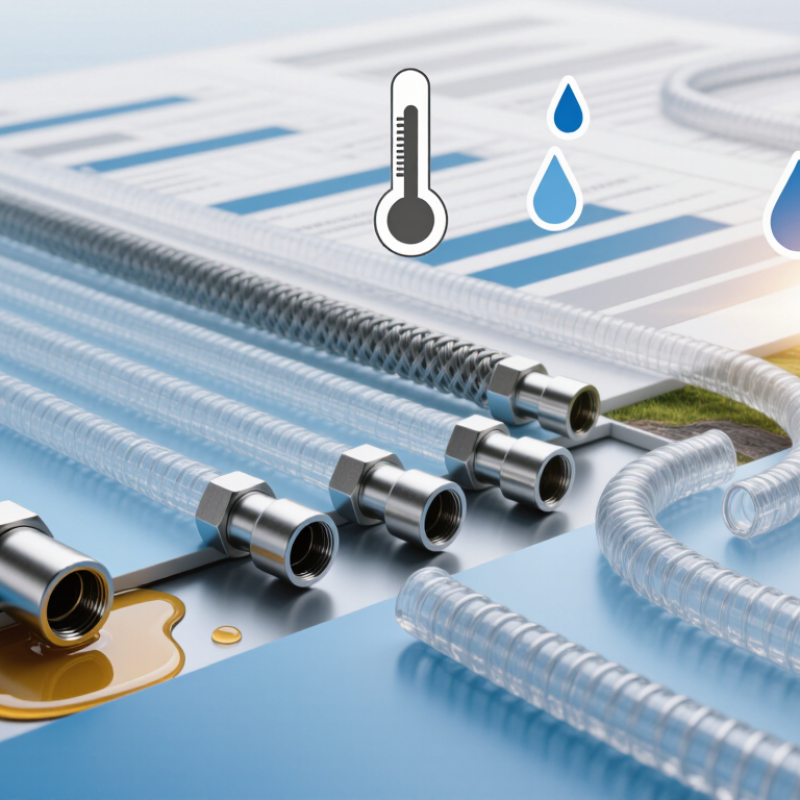
The bars show representative temperature ranges for common TPU and TPV hose applications, not universal material ratings. Actual limits depend on the specific grade, hose construction, pressure, fluid, and exposure duration. Check the product datasheet before specifying a hose.
For a fair TPU-versus-TPV comparison, start with the hose’s job, not a generic material ranking. Grand View Research estimated the global TPU market at USD 26.7 billion in 2023, but market growth does not prove a grade suits your application. Compare the actual compound and finished hose. Record working pressure, temperature range, bend radius, wall thickness, and fluid exposure. Check whether the figures apply continuously or only briefly. That distinction matters.
Ask for tensile strength and elongation tested to ISO 37, plus compression set tested to ISO 815-1. Abrasion results also need the test method and conditions; a number without them is hard to compare. TPU often offers strong abrasion resistance and flexibility, while TPV may suit applications needing heat stability and elastic recovery. Actual results depend on formulation and construction. Test the finished hose. Include fittings, because leaks often start there. A small caveat: published data sheets rarely match your exact fluid, temperature, and bend cycle. Request representative test reports, then trial a short hose section under real operating conditions. Sources: Grand View Research, TPU Market Size, Share & Trends Analysis, 2024; ISO 37:2017; ISO 815-1:2019.
A practical, material-level comparison for sourcing and specification review. Values are typical indicative ranges, not guaranteed limits for every hose construction or compound.
| Specification | TPU Hose | TPV Hose | What Buyers Should Check |
|---|---|---|---|
| Material description | Thermoplastic polyurethane; commonly supplied in polyester-based or polyether-based grades. | Thermoplastic vulcanizate; a thermoplastic matrix containing dynamically vulcanized rubber. | Request the exact polymer family, compound designation, and current technical data sheet. |
| Typical hardness | Common hose compounds are approximately 70 Shore A to 98 Shore A, depending on grade and construction. | Compound hardness varies widely; many hose compounds fall around 50 to 95 Shore A. | Compare hardness using the same test method and specimen conditions. Hardness alone does not predict hose flexibility. |
| Typical service temperature | Grade-dependent. Many general-purpose grades are used from about −40°C to +80°C; selected formulations may allow higher temperatures. | Grade- and design-dependent. Many TPV compounds are used across roughly −40°C to +125°C, with some grades rated higher. | Confirm continuous and intermittent limits, fluid exposure, pressure, and temperature together. |
| Abrasion and wear | Often selected for strong abrasion resistance, especially in conveying, pneumatic, and protective applications. | Can provide good durability, but abrasion performance varies significantly by compound and hose design. | Ask for the test method and measured result; compare samples under the actual wear conditions. |
| Flexibility and kink behavior | Available in flexible grades; flexibility depends on hardness, wall thickness, reinforcement, and temperature. | Can remain flexible across a broad temperature range; construction and wall geometry determine kink resistance. | Review minimum bend radius, vacuum resistance, and kink performance for the intended hose size. |
| Hydrolysis considerations | Polyether-based TPU generally offers better hydrolysis resistance than polyester-based TPU. Polyester grades may require extra care in hot, humid conditions. | Typically not evaluated using the same polyester-versus-polyether TPU distinction; compatibility still depends on the TPV compound and environment. | For water, steam, or humid service, confirm aging data for the exact grade and operating conditions. |
| Oil and chemical compatibility | Varies by TPU chemistry and the specific fluid. Compatibility should be confirmed for oils, fuels, cleaners, and process chemicals. | Many TPV compounds are used in automotive and fluid-handling environments, but resistance is fluid- and grade-specific. | Request a written compatibility assessment and immersion or aging results using the actual fluid. |
| Weathering and UV exposure | Performance varies by grade, pigmentation, and stabilization; prolonged outdoor exposure may require a UV-stabilized formulation. | Often used in weather-exposed applications, but UV and ozone performance depend on compound formulation and testing. | Specify outdoor exposure duration, color, UV stabilization, and the relevant weathering test requirements. |
| Appearance options | Can be clear, translucent, or colored, depending on the grade and additives. | Commonly opaque and colored; appearance depends on the compound and product construction. | Confirm whether transparency, color matching, or visual inspection of conveyed media is required. |
| Pressure capability | No universal pressure rating; depends on diameter, wall thickness, reinforcement, temperature, and end connections. | No universal pressure rating; depends on the same design factors and the selected TPV compound. | Compare rated working pressure, burst pressure, safety factor, temperature derating, and applicable test standard. |
| Typical application fit | Air and fluid transfer, abrasion-resistant conveying, protective sleeves, and applications needing clear or highly wear-resistant tubing. | Automotive ducting, flexible fluid or air lines, and applications where heat and weathering performance may be important. | Use the application environment—not the material name alone—to shortlist hose designs. |
| Processing and end-of-life | Thermoplastic material that can generally be melt-processed; reprocessing may affect properties and depends on grade and contamination. | Thermoplastic material with a vulcanized rubber phase; recycling routes and recovered-material properties depend on the compound and local facilities. | Confirm supplier take-back or recycling options and applicable local waste requirements. |
| Documents to request | Technical data sheet, chemical compatibility information, pressure and temperature ratings, and relevant test reports. | Technical data sheet, fluid compatibility information, pressure and temperature ratings, and relevant test reports. | Request traceability, dimensional tolerances, regulatory declarations, and lot-specific quality records where required. |
Specification note: Temperature ranges and other performance descriptions above are general screening guidance. Actual limits depend on compound formulation, hose dimensions, reinforcement, manufacturing process, fluid, pressure, and exposure time. Obtain written ratings and test evidence for the exact product before purchase.
Global sourcing for TPU and TPV hoses begins with a clear application brief. Specify the working fluid, temperature range, pressure, bend radius, and expected service life. A hose for a moving machine may need different flexibility from one installed in a fixed line. Small details matter. Include the inner diameter, wall thickness, end connections, and any required color or marking. Without these details, supplier quotations are difficult to compare.
Evaluate suppliers using samples and verifiable records, not only catalog descriptions. Ask for material data, dimensional checks, and test results that match your intended use. Ask for evidence. Check whether production samples stay consistent across batches, and confirm lead times, minimum order quantities, packaging, and change-control procedures. A neatly printed specification sheet is useful, but it does not replace testing under realistic conditions. For example, inspect a cut hose section and check its layers, finish, and fit with the intended connector.
A practical scorecard can compare technical fit, quality controls, communication, capacity, and total landed cost. Request written answers to the same questions from each candidate. No scorecard is perfect; freight delays and specification changes can still disrupt a plan. Build in time for sample approval and a small pilot order. If a supplier cannot explain a test method clearly, pause and clarify it before committing.